6 Types of Files You Can Feed NotebookLM (And Why YouTube Videos Are a Game-Changer)

When most people hear “AI research tool,” they assume it only works with text documents. Upload a PDF, get a summary. That’s the limit of what they expect.

NotebookLM goes a lot further than that — and the source types it accepts are exactly what makes it useful for the way Malaysian SME owners actually work. We don’t just deal in PDFs. We deal in webinar recordings, vendor training videos, government briefings, scanned forms, and links we bookmark and never get back to.

NotebookLM was built for exactly that kind of mess.

The 6 Source File Types NotebookLM Accepts

You can feed NotebookLM information in six different formats, and it treats all of them as grounded source material — meaning it only answers based on what you’ve given it, not on general internet knowledge.

1. PDF The obvious one. Reports, contracts, compliance guidelines, ebooks — anything in document form.

2. Audio Upload a recording — a meeting, a voice memo, a recorded call — and NotebookLM can process the spoken content as a source.

3. Image Photos of whiteboards, scanned documents, screenshots of slides — NotebookLM can read and use visual content too.

4. Website Paste a URL and NotebookLM pulls in the page content as a source, no copy-pasting required.

5. Google Drive Connect directly to your Google Docs or Drive files instead of downloading and re-uploading them.

6. YouTube video And this is the one that changed how I personally use the tool.

Why the YouTube Video Source Is the Most Underrated Feature

Most SME owners I know have a graveyard of “watch later” videos. A 90-minute webinar on SST compliance. A vendor’s onboarding training video. A conference talk someone shared in a WhatsApp group three weeks ago that you still haven’t opened.

With NotebookLM, you don’t have to watch any of it start to finish.

Paste the YouTube link in as a source, and NotebookLM processes the full content of the video. From there, you can ask direct questions — “What are the three main compliance changes mentioned?” or “What does the speaker say about pricing?” — and get answers pulled straight from that video’s content, without scrubbing back and forth trying to find the part you half-remember.

For a founder running a lean team, this is real time back. Knowledge that used to sit locked inside an hour-long video — knowledge you genuinely needed but never had time to extract — becomes something you can pull out in minutes.

How Malaysian SME Owners Can Use This in Practice

A few ways this fits into the way SMEs here actually operate:

  • Compliance updates. LHDN or MyInvois webinars are often long and dense. Drop the video in, ask NotebookLM to summarise what’s actually relevant to your business.
  • Vendor and software training. Instead of sitting through a full onboarding video again to find one setting, ask NotebookLM directly.
  • Conference and webinar content. If your team shares recorded talks or industry sessions, build a shared notebook so the knowledge doesn’t disappear into someone’s inbox.
  • Competitor or market research. Industry YouTube channels, panel discussions, and product walkthroughs all become searchable source material instead of passive watch time.

A Practical Starting Point

If you’ve never tried this, start small. Pick one video you’ve been meaning to watch but haven’t — a webinar, a training session, anything sitting in your “watch later” list — and add it as a source in NotebookLM. Ask it one specific question you actually need answered. That’s usually enough to see why this feature is worth building into your routine.

Frequently Asked Questions

Do I need to watch the video first before NotebookLM can process it?

No. NotebookLM processes the video’s content directly once you add the link — you can go straight to asking questions.

Does the YouTube video need captions or subtitles?

Generally, yes. If the video has auto-generated or manually added captions, NotebookLM can process it. Videos with no captions at all may not process well.

Can I add private or unlisted YouTube videos?

The video link needs to be accessible — public or unlisted videos with a shareable link generally work. Fully private videos restricted to specific accounts typically won’t.

Is NotebookLM free to use?

Yes, there’s a free tier that’s generous enough for everyday SME use, covering most of what’s described in this article.

How is this different from just asking ChatGPT about a YouTube video?

NotebookLM is built to work only from the sources you provide — it doesn’t blend in outside information the way general AI assistants can. For something like a compliance briefing, that grounded accuracy matters more than it might for casual use.

Can NotebookLM process videos in Bahasa Malaysia?

It depends on the captions available on the video. If the YouTube captions are accurate, NotebookLM can generally work with non-English content, though English-language processing tends to be more reliable at this stage.

Is this useful if I only run a small team?

If anything, it’s more useful. Smaller teams don’t have the bandwidth to re-watch long videos or assign someone to “go through this and summarise it.” NotebookLM does that work for you in minutes.

NotebookLM: The AI Research Tool That Actually Reduces Hallucinations (And Builds Slides Too)

Most business owners I speak to have tried ChatGPT at least once. Some use it daily. But there is a frustration I keep hearing over and over again — especially from SME owners who tried using AI for something specific to their business:

“The answer sounded right, but it was wrong.”

That is the hallucination problem. And it is not a small inconvenience. When you are using AI to research compliance requirements, draft product documentation, or prepare training materials — a confidently wrong answer is worse than no answer at all.

I have been exploring AI tools seriously for the past year, both for my own use and to understand what actually makes sense for the SMEs we work with at Authentic Venture Sdn Bhd. And recently, one tool stopped me in my tracks.

It is called NotebookLM. It is free. It is made by Google. And it solves the hallucination problem in a way that most other AI tools do not even try to address.

What Is NotebookLM?

NotebookLM is an AI-powered research and note-taking tool developed by Google. Unlike general-purpose AI assistants, NotebookLM does not pull information from the broader internet or rely on its training data to answer your questions.

Instead, it works exclusively from the sources you provide.

You upload your own documents — PDFs, Word files, Google Docs, even website links or YouTube video URLs — and NotebookLM uses only those materials as its knowledge base. Every answer it gives you is grounded in your sources. It will even tell you exactly which part of which document an answer came from.

This is a fundamentally different approach to AI, and for business use, it is significantly more reliable.

Why Hallucinations Are a Real Business Risk

Before we go further, let me be clear about what hallucinations actually mean in the context of AI.

When a tool like ChatGPT does not know the answer to something, it does not say “I don’t know.” It generates a plausible-sounding answer based on patterns in its training data. The answer can be grammatically perfect, confidently stated, and completely fabricated.

For casual use, this is annoying but manageable. You fact-check and move on.

But for business owners, the stakes are different. Imagine:

  • Using an AI to summarise your tax compliance obligations — and getting an answer that mixes up SST and GST rules
  • Asking it to explain your own product features — and having it invent capabilities your product does not have
  • Training a new staff member using AI-generated content — that contains inaccurate information

These are not hypothetical. These things happen when business owners use general AI tools without understanding their limitations.

NotebookLM sidesteps this problem entirely by not being a general AI. It is a your-documents AI. It only knows what you tell it.

5 Practical Ways Malaysian SME Owners Can Use NotebookLM

1. Grounded Research on Regulatory and Compliance Topics

Malaysian SME owners deal with a lot of regulatory complexity — SST filings, MyInvois e-invoicing requirements, EPF and SOCSO updates, PDPA compliance. The rules change, and the details matter.

With NotebookLM, you can upload the actual documents — the official circulars, LHDN guidelines, or compliance checklists your accountant shared with you — and then ask questions directly from those materials. The AI will answer based on what the documents say, not what it thinks they probably say.

This is especially useful for preparing for meetings with accountants or legal advisors. Come in with your own research, grounded in the actual source material.

2. Auto-Generating Sales Training Slide Decks

This is the feature that genuinely surprised me.

NotebookLM can generate a full slide deck based on the materials you upload. Here is how I would use this for an SME sales team:

  • Upload your product brochure, pricing sheet, and FAQ document
  • Ask NotebookLM to generate a sales training presentation
  • It produces a structured, accurate slide deck based entirely on your materials

What used to take a sales manager half a day to put together can now be done in minutes. And because it is sourced from your own documents, the content is accurate — not a hallucinated version of what your product might do.

This is the kind of time-saving that has real impact on a small team where everyone is already wearing multiple hats.

3. Building Staff Onboarding Materials

If you have SOPs (Standard Operating Procedures) documented somewhere — even in a Word file or a Google Doc — you can upload those into NotebookLM and ask it to turn them into training materials.

Ask it to generate:

  • A summary of key procedures for new staff
  • A Q&A study guide based on your SOP
  • A slide presentation for onboarding sessions

This works especially well if your SOPs are detailed but dense. NotebookLM can extract the essential points and reformat them for easier consumption.

4. Research Synthesis Across Multiple Documents

If you regularly read industry reports, client proposals, or market research, you know how time-consuming it is to synthesise information across multiple long documents.

NotebookLM lets you upload all of them together and then ask cross-document questions:

  • “What are the common themes across these three industry reports?”
  • “Summarise the key differences between these two supplier proposals”
  • “What does our Q1 sales report say about the product categories that underperformed?”

It will answer from the documents you uploaded and cite its sources. This alone can save several hours of reading and note-taking per week.

5. Preparing for Client Meetings and Presentations

Before an important client pitch, upload everything relevant — your company profile, the client’s publicly available information, your proposal draft, and any reference case studies. Then use NotebookLM to generate:

  • A summary of the key points you want to make
  • Likely questions the client might ask, based on the materials
  • A slide deck framework for the presentation

You walk into the meeting better prepared, and the preparation took a fraction of the usual time.

NotebookLM vs ChatGPT: Which Should You Use?

This is a question worth answering directly, because both tools have their place.

NotebookLMChatGPT
Best forWorking with your own documents and dataGeneral knowledge, brainstorming, writing
AccuracyHigh — grounded in your sourcesVariable — can hallucinate
Internet accessNo (works from uploaded sources only)Yes (with web browsing enabled)
CostFreeFree tier + paid plans
Slide generationYes, from your documentsLimited
Source citationsYes, cites the exact documentNo

The short answer: use NotebookLM when the accuracy of the answer depends on specific documents or your own business content. Use ChatGPT for open-ended tasks where you want creative output or broad knowledge.

For most day-to-day SME tasks — training materials, compliance research, client prep — NotebookLM is the more reliable choice.

How to Get Started with NotebookLM

Getting started takes less than 10 minutes:

  1. Go to notebooklm.google.com
  2. Sign in with your Google account
  3. Create a new Notebook
  4. Upload your sources — PDFs, Google Docs, website links, YouTube URLs
  5. Start asking questions in the chat interface on the right

That is it. There is no complex setup. No paid subscription required for the core features. Just upload your documents and start working.

A Note on How This Fits Into a Bigger System

Tools like NotebookLM are powerful on their own. But where they become truly transformative is when they sit on top of a well-organised business foundation.

At Authentic Venture, the SMEs we work with are building that foundation – structured financial data, streamlined HR processes, automated invoicing through MyInvois, inventory management that actually reflects reality. When your core business operations are running on a reliable system, every productivity tool you add on top of it multiplies in value.

An AI tool is only as useful as the documents and data you feed it. If your SOPs are scattered across WhatsApp messages, your product info lives in someone’s email draft, and your financials are in a spreadsheet no one has updated since March – the AI cannot help you much.

Build the system first. Then the tools work for you, not the other way around.

Final Thoughts

NotebookLM is one of the most practically useful AI tools I have come across for SME business owners — precisely because it does less than most AI tools. It does not try to know everything. It only knows what you teach it.

And that constraint is exactly what makes it trustworthy.

If you have been hesitant about adopting AI in your business because you are not sure you can trust the outputs — NotebookLM is a good place to start. Upload one document. Ask it one question. See how it works.

You might be surprised how quickly it earns a permanent spot in your weekly workflow.

Frequently Asked Questions (FAQ)

Q: Is NotebookLM free to use?

Yes. NotebookLM is free to use with a Google account. Google also offers NotebookLM Plus as a paid tier with higher usage limits, but the core features — including document upload, Q&A, and slide generation — are available on the free plan.

Q: Does NotebookLM work with Bahasa Malaysia documents?

Yes. NotebookLM can process documents written in Bahasa Malaysia. You can upload Malay-language PDFs or documents and ask questions in either English or Bahasa Malaysia. The quality of responses may vary depending on how clearly the source documents are written, but it does support multilingual content.

Q: How many documents can I upload to NotebookLM?

On the free plan, you can upload up to 50 sources per notebook. Each source can be a PDF, a Google Doc, a copied text, a website link, or a YouTube video URL. For most SME use cases, this is more than sufficient.

Q: Is my uploaded data private and secure?

Google states that your NotebookLM data is not used to train their AI models. However, as with any cloud-based tool, you should exercise caution about uploading highly sensitive or confidential business documents. For general business documents, training materials, and product information, the privacy risk is minimal. Always review Google’s current privacy policy for the most up-to-date information.

Q: Can NotebookLM replace a human researcher or content writer?

No — and it is not designed to. NotebookLM is a tool that helps you work more efficiently with information you already have. It synthesises, summarises, and reformats. It does not generate original insights, strategic recommendations, or creative content the way a skilled human does. Think of it as a very fast, very accurate reading assistant.

Q: How is NotebookLM different from asking ChatGPT to read a document?

When you paste a document into ChatGPT, it reads it — but it may also mix in information from its training data when generating responses. NotebookLM is architecturally designed to use only the documents you upload. It is built for source-grounded responses, which makes it more reliable when accuracy matters.

Q: I run a small business in Malaysia. Is this tool relevant for me?

Absolutely. In fact, NotebookLM is particularly well-suited to SME owners in Malaysia who manage compliance documents, train small teams, and need to prepare client-facing materials regularly. The time savings on slide creation and document research alone can make a meaningful difference in a lean team.

CEO of Authentic Venture Sdn Bhd

It is the first working day in 2022 and it has been quite a hectic day =)

Year 2020 and 2021 has been a challenging year for all of us – for majority of companies worldwide. With the pandemic, and major shifts in how businesses are run, companies can no longer afford to stay still or take a “wait-and-see” strategy. It has been a fast year – either you’re on the bandwagon, or you’re going to be left behind.

Technology has become something very important, very crucial. It is no longer just a tool – it’s an integral part of the organisation – from back office tasks to generating revenue for the company. OfficeCentral has grown from providing back office solutions for our customers such as HR, Payroll and Accounting, to modules that focus on generating revenue for the companies.

The Covid-19 pandemic has pushed us, all of us, to embrace technology – it does not matter whether you’re a business, or an individual. During the difficult time, technology has enabled us to continue our businesses and communicate with our family and friends. And technology is here to stay (Although, we hope Covid-19 will go away).

At Authentic Venture Sdn Bhd, we start the year 2022 with a huge restructuring in the company. It has been our dreams to move the company to the next level, and the restructuring is done with this in mind. We are putting forward our best, so that we can deliver the best to our customers and stakeholders. We want to deliver the best to you.

Khairun Nisa Aziz, CEO of Authentic Venture Sdn Bhd

Alhamdulillah, effective today, I am the new Chief Executive Officer of Authentic Venture Sdn Bhd. It is a huge responsibility, and a huge challenge for me. Our former CEO, Ir Aziz Ismail, will be moving up to be the Executive Chairman of the company.

With these changes, there will be a lot of work to be done. Pray for us!

We believe that in order to go far, we will have to work hard together – And I am looking forward to working with you, our partners, our customers and more in order to provide the best to you and to be the best in the industry. As per our motto, your success is our success.

Thank you.

business #business #technology #thankyou #work #leadership #success #growth #strategy #ceo #officecentral #authenticventure #authenticventuresdnbhd

Individual Differences – What make up a person’s behavior?

Each person is different from another person. What we can observe is a person’s behavior – how we behave, how we talk and do something. However, what actually make up a person’s behavior conststs of several factors which are not visible.

Much like the iceberg below:

Behavior

Our knowledge and skills, attitude and values, beliefs and personality are the factors that make up our behavior. These are the reasons why we act the way we do, and why one person is different from another.

Let us go into detail on Personality factor that influences our behavior.

Personality is…

  • relatively stable across different situations;
  • enduring across time; and
  • expressed through patterns of behaviours that distinguish one person from another.

From our own observation, we can actually see / describe the personality of people close to us, as it actually relatively consistent across context.

We also normally observe that certain personality types gets along well with certain types of personality.

Personality differences, for example, can lead to interpersonal antagonism, which can stymie the formation of productive teams. However, the appropriate balance of personalities can lead to the formation of effective teams.

In the personality theories, there are 2 major approach:

  1. Nomothetic approach: This approach strongly supports the view that personalities are fixed and determined by heredity, and cannot be significantly influenced by environmental factors.
  2. Idiographic approach: This approach takes the opposite perspective – It recognizes that individuals do have unique innate charateristics, it also suggests that personality can be moulded and that both personality and behavior and influeced by specific environmental experiences.

(Organisational Behaviour, Individuals, Groups and Organisations by Ian Brooks)

There are various studies on personality, which I will share in my next post. By understanding this and how to apply this in your hiring and team development, it will greatly help you and your team to achieve better fit and becoming more productive team.

4 Leadership Lessons from Shackleton

Remember the Case Study I shared previously on Shackleton?

In this post, I would like to share the summary – 4 leadership lessons from Shackleton. Even though we may not face life-and-death situation like Shackleton did, but the lessons can help us to better ourselves in our leadership journey.

4 Leadership Lessons from Shackleton Case Study

As we can see here, Shackleton managed to easily toggle his focus on daily operations and also leading the mission. He also takes full responsibility, visionary in the humanity and also has the discipline to continually move forward. These 4 are very important leadership values in order for us to be successful in achieving our goals.

How do you see these values impact in your daily life as a leader?

Case Study: Shackleton

One of the case study on leadership is on Polar explorer Sir Ernest Shackleton.

It’s an interesting story, of how a journey to explore and walk across the continent of antartica, became a journey to survive. He needed to manage his team’s energy to ensure that they survive the perilous journey.

You can read more about this Case Study here:

https://hbswk.hbs.edu/item/shackleton-an-entrepreneur-of-survival
https://www.nytimes.com/2011/12/25/business/leadership-lessons-from-the-shackleton-expedition.html

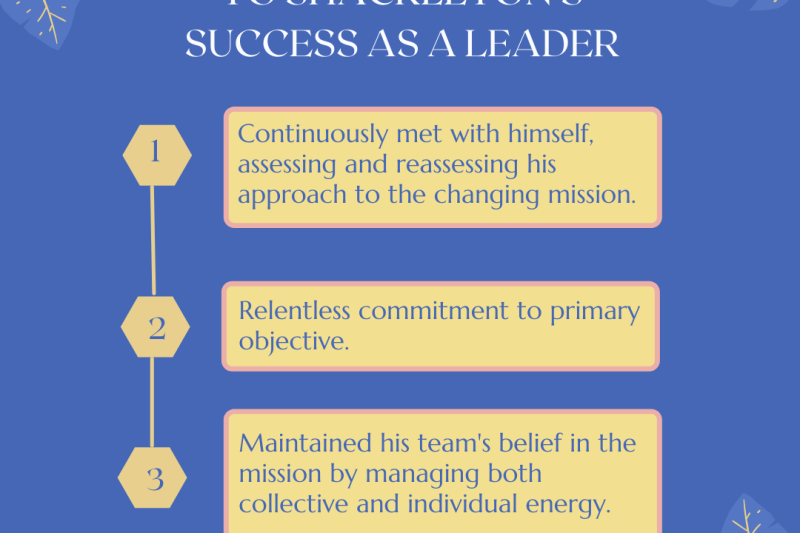
It’s a story full of leadership and management lessons. The 3 practices esstial to Shackleton’s success as a leader:

  1. He continuously assess and reasses his approach to the changing mission. This allows him to reflect and see the best approach to achieve the mission’s objective.
  2. He showed relentless commitment to his primary objective – the safe return of his tem – while being entirely flexible about how to achieve it. This allows him to find the best way on how to achieve the objective, rather than stick to one method only.
  3. He maintained his team’s belief in the mission by managing both collective and individual energy. By having good team’s energy, they are able to work together to achieve the missions, and avoid giving up on the objectives.

Shackleton also practiced “keeping your friends close, and your enemies closer”. He identified the team members who may be threat to keeping up the team’s energy to stay in the same tent as him, so that he can manage them closely. This shows that you have to manage the enemies of change so that they do not take the mission off course.

A lot of leadership and management lessons can be learned through this Case Study.

Main Forces that Affect Team’s Energy

I have shared 3 main forces in my previous posts, today I would like to share 5 more main forces on this topic. These are some of the points that I learned in the MBA class I am taking currently – People, Work and Organisations. The book that we use in this class is Organisational Behavior by Ian Brooks (Fifth Edition).

Firstly, you need to have purpose, goals to achieve. When the company or organization set clear goals for their team, the team will be more energized and focused on the same goals.

Then, understand that each individual is different. They are a part of a team – but the factors for their motivation differs from one another. Some may like the challenge, some may like the financial motivator, and more. You cannot use one size fits all in managing each person’s motivation.

Of course, one of the most important aspect in building your team is the hiring part. It can make or break your team. Ensure that you hire those with positive attitude, grit and positive outlooks.

Then, by having cross-functional teams that fosters collaboration – you can achieve better results, and increase the team’s energy. Marketing and design teams, design and engineering / development teams, sales and customer success teams, and a variety of other teams that find mutual advantage in collaborating and working toward a similar objective are examples of cross functional teams.

And last but not least is the team cohesion and bonding. This is one of the topic I discussed with one of my teammates today. We were talking about some historical stories about the company, team and improvements over the years. My teammate brought up that good bonding we have in the company helps to solve a lot of problems. It makes the work more fun and enjoyable. By having good team cohesion and bonding, many problems can be solved easily – as this allows better communication and teamwork. That is why teambuilding activities are actually important (it’s not just for fun) and the team members should be encouraged to work closely with one another and build bonds through projects, learning and helping out each other.

I am glad I had a good chat with him today – I felt, this too is a part of building bonds. It was quite enjoyable and let us learn more about each other too.

Aku Negaraku

Today I am feeling a bit patriotic.

I love my country, Malaysia.

Malaysia is great. And I believe all of us Malaysians are striving so that we can always improve and be the best version we can ever be. So that Malaysia can be the best country we can ever be.

I always believe Malaysia is the best country to live in, to build my family, to give my children the best environment to grow in.

I hope I can contribute to helping Malaysia to be better too.

When I was younger, someone said to me “Don’t ask what your country have done for you. But ask, what have you done for your country?”.

I felt that I have not achieved much in my past 35 years of life. But I hope every single step I took and will take, will be towards achieving my dreams – of contributing to Malaysia and to the Muslims all over the world. To bring up my beloved country to be the best, and to help all the Muslims wherever they are.

This has been my ambition, and it will always be.

Let’s work together to grow Malaysia together. It’s our future. It’s our children’s future.

Selamat Hari Kemerdekaan yang ke – 64, Negaraku Malaysia.

Team’s Energy: Involve People in Sorting Out and Dealing with Situations

One of the main forces that affect the most on a team’s energy, is involving people in sorting out and dealing with situations.

The wording is quite straightforward and I believe that most understand what it means.

So in this post, let me share my story.

I am a problem solver – and I like to move fast. So usually if I / we face with certain problems and I know how to solve it – I usually just proceed with it without much discussion.

So what I did previously, is I always try to solve everything by myself – unless it is something that I really don’t know how to solve it (Usually if I had issues with very deeply technical things – I would let my brother/sister to solve them).

Even though I managed to solve the problems fast, but a few issues arised:

  1. Of course I felt tired and frustrated because I felt that I have to do everything by myself (this is so plain negative thinking actually – other people wanted to help, but I didn’t give them the opportunity).
  2. Non inclusive community – my team would feel that I am the one who call all the shots, and they felt like they were not included in decision making process. This makes them felt like they are not part of the team. So here, it becomes like receiving instructions and carrying them – this lowered team energy level.
  3. The solution may not be the best – As I proceed with my own knowledge and experience without taking into consideration others’ knowledge and experiences.

This happened due to I felt the need to be in control in every different aspects in the business. However, by doing this, I was also becoming the bottleneck in the company.

Along the way, I tried to learn how to let go. It’s hard, but it is required for us to grow.

Letting go does not mean not caring. It is actually putting trust in your team.

By letting go, I am actually giving opportunities to the team members to sort out the problems we faced and deal with situations. This gives opportunities for them to learn, sharpen their problem solving skills, and also leverage on knowledge and experiences of more people – thus, getting to much better solutions in the long run.

Sometimes, I need to be the facilitator in the problem solving process, but most of the time, they actually know how to solve them. Not only this free up my time to focus on growth, but also the team members felt a part of the team, and have a stronger bond.

All these years, I see that those who I let them be involved in sorting out and deal with situations by themselves / among the team – they grow faster, they can level up much better and I can rely on them more, than those who don’t.

Imagine if you were an apple tree

A few years back, I used to visit counsellors to get counselling sessions. Those years were very challenging years as I was tested not only in work-related areas, but also friendships, financial and more.

The first counsellor I met, opened my eyes to the world of counselling. From that day onwards, I believe counselling plays a big role in mental and emotional health.

During the first session, one of the question that was asked to me,

“What if you were an apple tree?”

Person A came to you and water you. How would you respond?
Person B came to you and climbed you to get the apples. How would you respond?
Person C threw sticks at you to get the apples. How would you respond?

As a normal human being, of course I feel like throwing sticks back at Person C. Haha.

But, as an apple tree, our objective is actually to produce apples. So, who cares what other people do? Why do we need to retaliate or respond negatively when we perceive other people as treating us negatively? Sometimes that’s the only way that they know how to get something or to get response from us.

Person A came. We give them good apples.
Person B came. We give them good apples.
Person C came. We give them good apples.

At the time when Person D came with an axe to chop us down, Person A, B and C will inform that we produce good apples and stop us from being cut down.

This story opened my eyes. Why do we treat people like how we feel they treated us? No matter how they treat us, we should always treat them well.

Sometimes, this is easier said than done. As usual, to develop a new habit, you need to consciously make the good decision, until it comes naturally to you.

Alhamdulillah, the multiple counselling sessions I had attended over a course of few years managed to help pull me out from depression that I faced at that time.

I know, sometimes I tend to forget the teachings and reacted like any normal person would. But as always, I try to reflect back to the counselling sessions and remember all the helpful councillors.

I am grateful.

If you are constantly sad, stressed or depressed, and have never met with a counsellor before, you should.

counselling #apples #react #positive